
ACTUAL REALITY
Discover ‘Actual Reality’, a people-powered experiment in bridging “Digital Divided” people, communities and places across County Durham.
It’s part community-generated artwork, part action research project and part DIY digital accelerator, powered by easy-to-ignore communities experiencing challenges around digital connectivity and opportunity through experiences of socio-economic, health, age and geographic infrastructure realities. The project is led by OGRE Studio and funded in partnership with Google Arts & Culture and Arts Council England.
*This is a live project update page. Last updated Tues 2 June 2026.
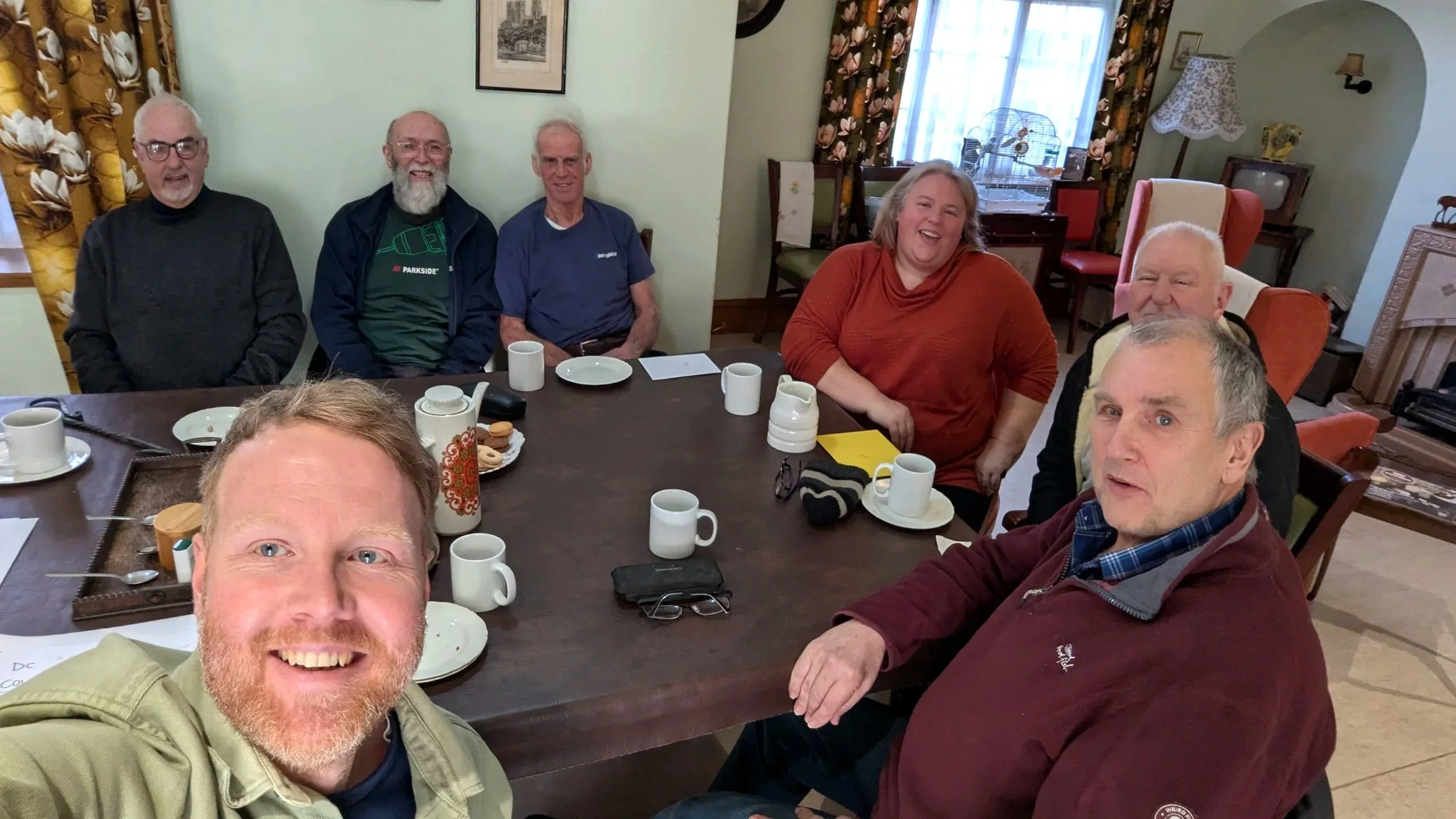
Image: Workshop selfie with Steven Walker from OGRE Studio (bottom left), Catherine Appleby from Beamish Museum (3rd from right) one of the two Beamish Museum Men’s Groups who took part in the group conversations that captured lived experiences via 13 conversation prompts which were used as contextual target user-group context to inform the Large Language Model used to create the brain of the ‘Durham Digital Voice’ AI app.
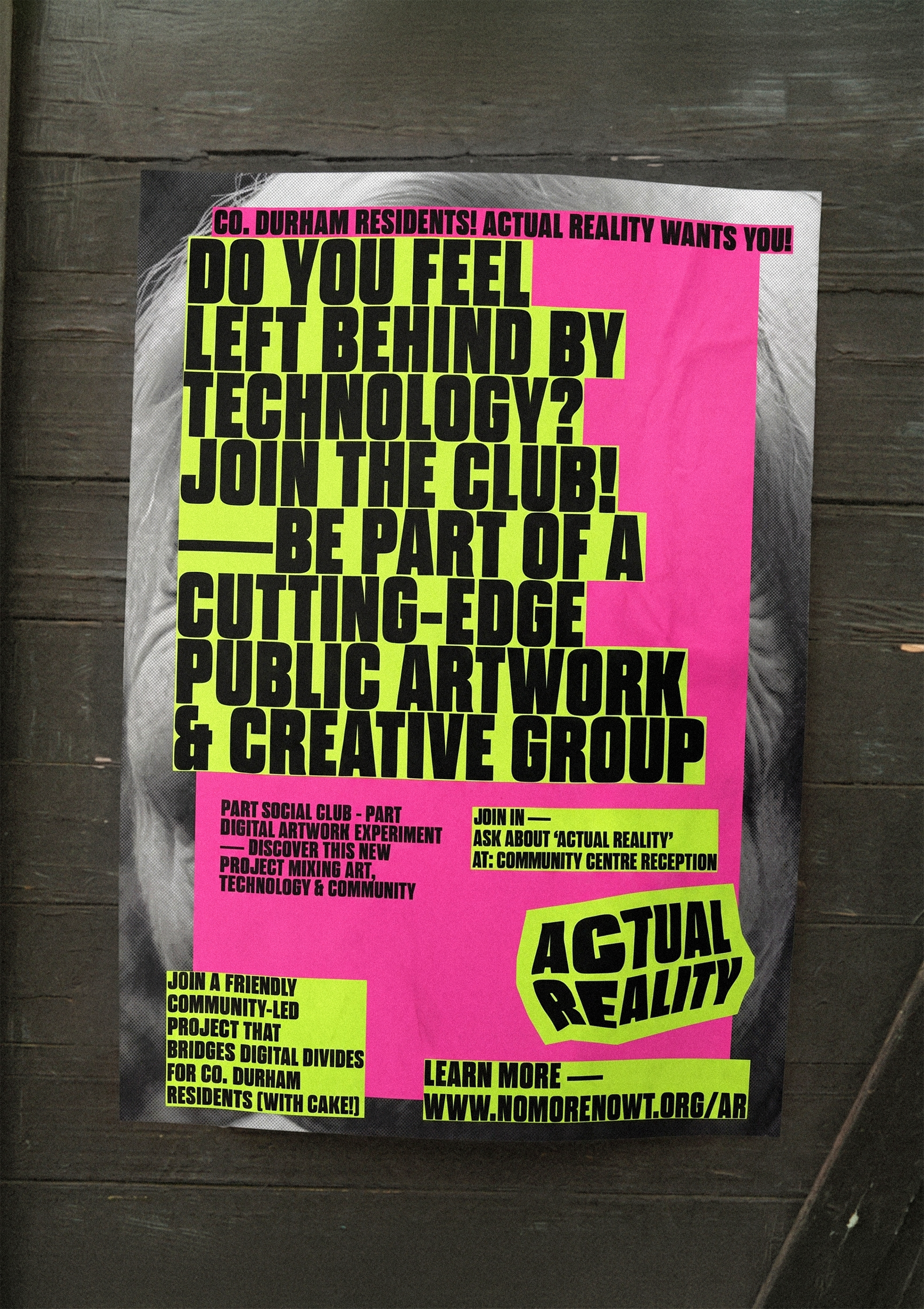
Image: A community call-out poster for the project on an allotment gate.
“A big [and unexpected] thing that we discovered was that whilst focusing on work to explore bridging the “Digital Divide”, we were also bridging generational divides.”
— Steven Walker, OGRE Studio
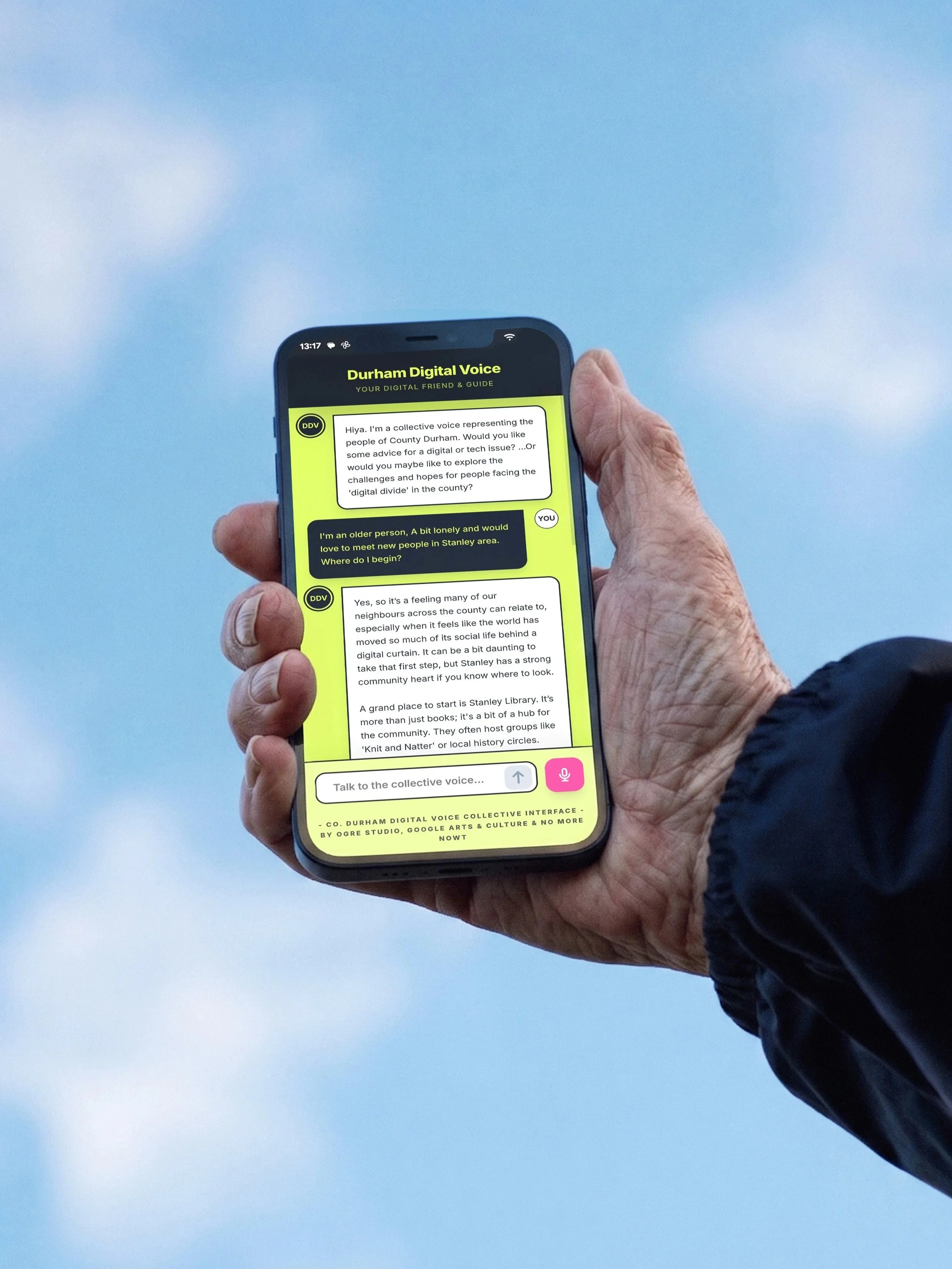
Image: The 'Durham Digital Voice' app in use. The hand of an older person is holding a smartphone showing an active conversation.
Findings and further context from the initial phases of the project: (Continued)
DIY Culture & Technical Innovation
Research explored the tension between existing infrastructure and "new tech" opportunities.
Key Insight: Participants felt a paradoxical "freedom" in living more analogue lives away from digital tracking because of their lack of connection to the features of our digital lives, whilst also feeling empowered by their own analogue skills.
The Cyberdeck: This led to a Phase 2 prototype: a physical, offline, location-responsive "cyberdeck" This handheld "oracle" uses GPS to provide thematic "divine signs" based on the user's position in the county, blending nostalgic hardware with embedded systems.
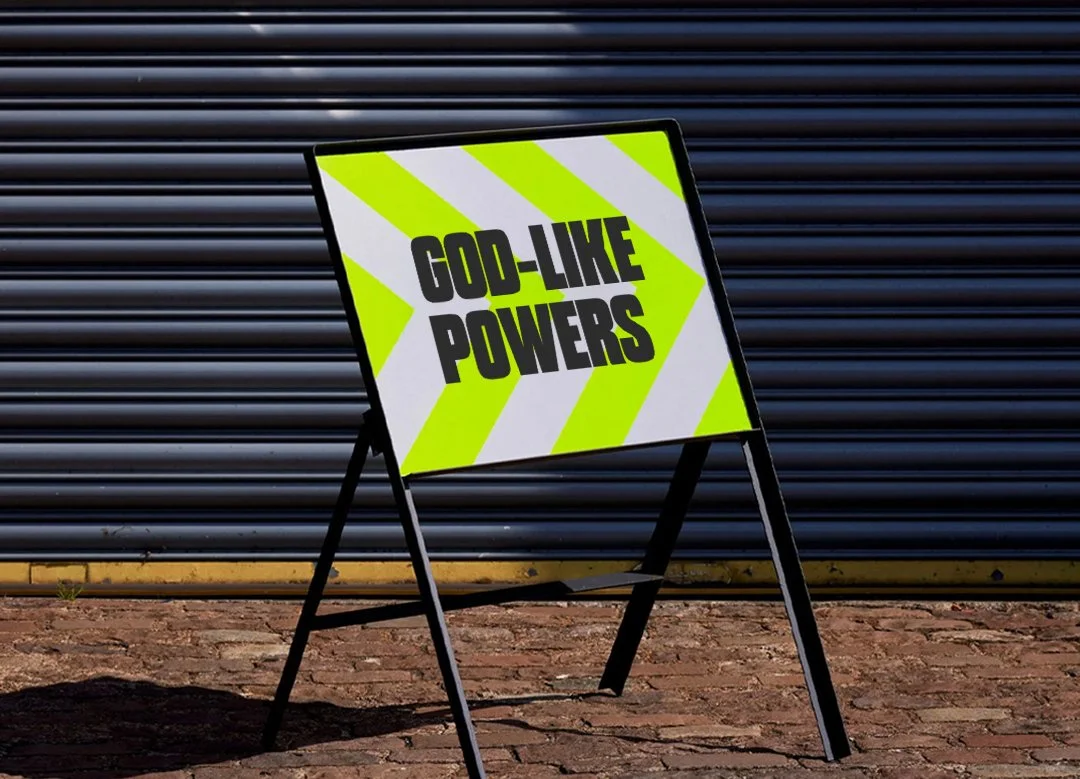
Image: ‘God-like Powers’. 2026. Roadsign intervention prototype capturing participant conversations on where technology is heading.
Operational Regional Context: Insight, Issues and Challenges Faced
As NMN already has a robust community partnership network (Cultural Hubs), we linked into this trusted gatekeeper group to explore fast traction in community engagement - workshops and drop-in’s resulted in initial community building and data collection.
However, we also wanted to explore new connections. Some of these saw extremely useful and deep-rooted engagement, like with several workshop sessions held with two groups from Beamish Museum’s Men’s Group - predominantly older, retired men and those experiencing social connection or health issues.
However, there were other (new to us) partnership organisations that we’d identified as likely being a good fit early on, like Age UK County Durham and various local authority projects/departments, linked to by the brilliant Eileen Perrie in the culture team, but new partnerships with these proved to be too burdensome for their staff at a time of entrenched capacity/funding challenges. This was understandable and we thank the people who we’re wanted to get involved, but we’re unable to do so.
This was a real challenge and risked our engagement numbers being too low for the sample volumes needed to “train” the AI that OGRE Studio was developing to support the target audience, so we took the action to conduct several “community hangouts”, delivering half-day town centre recce trips to seven areas resulting in a satisfactory data collection volume.
However, the challenges we encountered for the project are symptomatic of larger systemic issues facing the county.
Key Achievements
The 'Durham Digital Voice' AI - Built in Google AI Studio, this "non-human collaborator" is designed with altruistic intent to assist those struggling to articulate digital queries. Prioritising trust, the interface also serves as a source of companionship for isolated individuals - here: https://durham-digital-voice-925858915757.us-west1.run.app/
Co. Durham Digital Gathering - A pivotal early January 2026 event at Redhills Miners Hall drew 90 attendees. Artists, partners, and residents engaged in show-and-tells and imaginative talks regarding the future of digital creativity and citizenship. This validated the project’s impact, interest and positioned "easy to ignore" residents as primary stakeholders in a regional digital strategy.
As an action research project Actual Reality operates at a pretty fractious intersection of post-industrial decline and rapid digital acceleration, and political polarisation within County Durham, a region where the 'Digital Divide' isn’t just a gap in access, but a chasm of systemic exclusion rooted in decades of layered central government under-investment since the negative impacts associated with the closure of the Durham Coalfield and its many nuanced rippling effects felt keenly by easy-to-ignore people and places today. As essential public services migrate, sometimes exclusively, online, the local population finds itself caught in a paralysing contradiction: a growing, well-founded suspicion of tech-sector ethics and data privacy that feel oppositional to trade-unionist values, set against an absolute, unavoidable dependency on digital platforms for modern survival.
This friction is exacerbated by a local support infrastructure that is currently pushed to its operational limit - comprising local authority departments and multi-agency partners like Age UK Durham and other independent initiatives.
This polycrisis austerity and resource exhaustion has meant that some hopeful new explorative partnerships with the Actual Reality project have been/felt logistically unviable at this time for decision-makers in these organisations - ironically and importantly, the strongest evidence for the project’s necessity. They will be offered opportunities for inclusion into the project/programme going forward however.
By centering the lived experiences of the digitally disenfranchised, Actual Reality doesn’t just aim to 'plug people in', but to amplify the voices of those experiencing this paradox and have a new sense of agency, understanding and control though contributing their creative voice within it. Proving that in a landscape of institutional fatigue, community-led intervention is an incredibly empowering, radical action, and a way to build a bridge across their own, individually different, digital divides to (re)connect with a wider community to improve wellbeing, opportunities and pride in the places they belong and can build.
Findings and further context from the initial phases of the project:
Empowerment Through Collaboration
The project reached its goal of empowering divided groups by approaching participation as co-creation, ensuring collaborators understood that their engagement meant they were directly informing the first major code artwork of the project - their expression was making the entire context of the art works.
Progress: Engaged 17 community organisations, inc. Durham County Council to reach target audiences.
Partnerships: Redhills Miners Hall and Beamish Museum’s Men’s Group provided a bedrock for testing digital art resonance in traditionally non-digital spaces.
Data: Collected c.50 in-depth survey responses, directly informing the 'Durham Digital Voice' AI, reflects local linguistic nuances (a Northern female accent was suggested as most trustworthy amongst participants) and meets accessibility needs of older users.
Process as Product & Vice-Versa
The Actual Reality project has transitioned from a conceptual idea into a multi-generational digital art incubator of sorts, bridging "IRL and URL" in playful and quietly revolutionary ways, whilst mindfully operating with ethical tech practices at a time when this is seemingly more and more difficult to balance.
With an output that ties product and process together as one, the collective is making code, Large Language Models and digital products as art, which is really exciting going forward into the next stages.
At this point the first response to the collective thinking has resulted in the development of the 'Durham Digital Voice', an AI chatbot and interface that is publically available via any browser - along with various analogue-electronic interventions coming next. The project’s name/ethos has also been adopted as the title for NMN’s 2026–2029 digital programme.
“This project is proving that bridging the nuances of the “Digital Divide” as a cultural space for creative, community exploration - rather than approaching it as just a ‘training' or infrastructure problem - creates fertile ground for a pretty radical repurposing of advancing tech through equitable, collective co-creation that’s really powerful for people in Co. Durham [or anywhere].
The project’s end-users were directly informing the digital interventions we we’re making to explore the aims of what “bridging” [of the Digital Divide] could mean for us. The most valuable part of the process was in being together with the project’s participants; generally older people or people living with mobility, health or social isolation issues and ‘normalising’ the product design process directly with them.
We expected it, but we’re still always blown away at the appreciation of the power of conversation when building highly technical stuff, developing a real understanding of advanced tools with coding and electronics, etc., but also when considering chatting around how we develop the projects coding and technology as art in themselves, and to put out products into the world for social utility/good which brings people together.
Granted our approach has quite a punk/radical ethos or flavour behind the process in creating and launching new design, products, apps or cyberdeck type devices, but [for example] even though our facilitation of group conversations was decidedly open, rather than leading on a particular theme, participants frequently talked about how technology in general was becoming “like Syknet” [from the Terminator films] or had other sci-fi dystopian sentiments, or beyond that - like our tech is becoming “God-like”, discussing themes of belief structures in where we’re heading… all influencing the following phase of the project, but for the first phase, we’ve created a digital friend and guide in the form of a chatbot app named “Durham Digital Voice” as our first digital artwork for Actual Reality.
Ultimately, we’ve encoded collective experiences, challenges and frustrations into something that’s both a solution, a product and a code-based artwork. Next we’re continuing to explore technology in quite an analogue, DIY electronics way that reclaims accessibility of handheld technology and expresses some of the profound things our participants have said. We’re also creating everyday interventions by the way of typographic reappropriations of objects like road signs and public notices. These are in ways which are at odds to the closed black box mystery devices we’re all familiar with these days through our networked physical personal devices. And we’re building a community of interested people, so join us!
— Steven Walker, OGRE Studio
Project Acknowledgements:
— The brilliant No More Nowt Cultural Hubs (special mention to Thornley Community Centre and TCR Hub)
— Beamish Museum and Beamish Museums Men’s Groups, and the brilliant staff who supported us.
— Redhills Durham Miners Hall.
— Produced by OGRE Studio.
— Everyone who contributed to the guided conversations for data capture.
— The handy Co. Durham bus stops town centres and talkative commuters in places like Ferryhill, Spennymoor, Thornley, Stanley, Annfield Plain, Consett and others.
— Gear from Raspberry Pi, CircuitPython and Bambu Labs, code made with Python, AdaFruit, Google AI studio.
— Commissioned by Google Arts & Culture, and supported by No More Nowt and Arts Council England.